Flozi: How to Go from Invisible to Cited in ChatGPT, Gemini, and Perplexity
Your content feeds ChatGPT, Gemini, and Perplexity but you get no credit. Flozi diagnoses why AI drops your brand and gives you a plan to fix it.

Anil Choudhary
AEO Technical Associate

Your Content Is Already Feeding AI Answers. You Just Don’t Get Credit.
Flozi is an AEO (AI Engine Optimization) platform built for Webflow sites. It covers four stages of the workflow: diagnose and track your AEO progress, so the full loop from diagnosis to ongoing monitoring lives in one place.
You search for your own topic on ChatGPT. Nothing. You try Gemini. Nothing. You ask Perplexity. It gives a detailed answer that sounds a lot like something on your site, names three competitors, and doesn’t mention you.
So you do what most people do: you check your SEO. Rankings look fine. Content is solid. Traffic hasn’t collapsed. But something has clearly shifted, and none of the usual playbooks tell you what to do about it.
Here’s the thing. The problem isn’t your content. It’s that AI systems are consuming it, using it, and crediting someone else. Or worse, crediting no one and just explaining your ideas as if they’re general knowledge.
This is a retrieval and attribution problem. It needs a different playbook to diagnose and fix.
We’ve spent the last year building that playbook. Here’s what we’ve learned.
How Do AI Answers Actually Decide What to Include?
Most people think AI visibility is binary: you’re either in or you’re out. It’s not. There are three stages, and each one fails differently.
Retrieval. Can the AI even find your content? This happens before the LLM does anything clever. It’s mechanical. Are your pages indexed in the layers that feed ChatGPT, Gemini, and Perplexity? Are your content chunks semantically tight enough to match query intent? Is your site in a format crawlers can parse? Fail here and nothing else matters. You could have the best content on the internet and the AI would never see it.
Inclusion. Your content got retrieved. Great. But so did ten other pages. Does the AI pick yours? This is a competition. The LLM compares your content against everything else it pulled in, and the AEO Content Model. If a competitor wrote a tighter page on the same topic, they get the slot. If your own site has three pages that half-cover the same query, none of them look definitive, which makes it even easier for a competitor’s single focused page to take it.
Attribution. Your content got used. But did anyone get told it came from you? This is the failure mode nobody talks about. The AI absorbed your ideas, explained your framework, echoed your logic, and never mentioned your name. You’re ghost-writing for an answer that’s helping your competitors.
Most site owners have some awareness of stage one. Almost nobody is measuring stage two or three.
What Causes a Website to Disappear from AI Answers?
Let’s get specific about where things break.
Why retrieval fails
Retrieval breaks down across four layers:
Technical eligibility. Pages blocked by robots.txt, rendered in JavaScript crawlers can’t execute, or too slow to fully load. If the page isn’t accessible, it doesn’t enter any index.
Semantic alignment. The page is crawlable but no chunk on it matches the query’s meaning closely enough. The content exists but how AI selects sources.
Chunk dominance. Multiple pages on the same site are nearly identical in relevance, so the system can’t confidently pick one. We call this semantic blur in AI selection. It’s measured as the similarity gap between your top-matching chunk and the second-closest internal chunk. Low gap means you’re competing with yourself, and AI systems respond by skipping you entirely.
Format survivability. Key information is buried in images, locked in unreadable PDFs, or scattered across interactive elements that don’t translate into clean text chunks.
Why competitors get included instead of you
Even after retrieval, the LLM is choosing between candidates. Here’s what tips the scale:
Specificity wins. Answer-First Content Structure beats a broad page that touches on it. Depth matters more than domain authority.
Structure wins. Clear headings, comparison tables, explicit “when to use X vs Y” framing. These patterns make content easier for LLMs to extract. Unstructured prose loses to structured alternatives.
Cannibalization kills your odds. Three pages partially covering the same topic means none of them look definitive. One authoritative competitor page wins by default.
Missing comparative coverage gets you skipped. When users are evaluating options, content that doesn’t acknowledge alternatives or position itself within a category just doesn’t get picked.
Why AI uses your content but drops your name
Here’s the metric that makes this visible: the track your answer share. How often your content is used versus how often your brand is actually named. A 1:1 ratio means strong attribution. A 10:1 ratio means you’re ghost-writing for AI.
Attribution fails when:
The language is too generic. Generic phrasing gets absorbed without a trace. Named frameworks, proprietary terms, and specific methodologies create what we call gravity phrases : language so distinctive the AI has to attribute it.
Ideas aren’t tied to a name. The framework gets explained, but the content never connects it to a brand. AI systems don’t infer ownership. It has to be stated.
The content teaches instead of taking a position. Explainer-style content is easy for LLMs to synthesize and strip of origin. Content that names its approach and frames the topic through a specific lens is much harder to decouple from its source.
Sites that rank well in traditional search are the most vulnerable here. They’re signals that force AI attribution.
How Flozi Finds and Fixes AI Visibility Problems
Flozi is an AEO platform for Webflow sites. Answer Engine Optimization across ChatGPT, Gemini, Perplexity, and every other system pulling from the web.
The platform has four layers: discovery, advise, build authority, and track. Each one targets a different part of the problem. Here’s how they work together.
The AEO Discovery: Where You Actually Stand
Before optimizing anything, you need to know where you actually stand. Discovery gives you that.
It starts by crawling your entire site and running intent classification: grouping pages into clusters by what they’re actually for (informational, transactional, comparative, navigational) and flagging clusters that overlap. Overlapping intent clusters are almost always the root of semantic blur. You can’t fix cannibalization without first knowing which clusters are competing.
Then each cluster runs through four checks:
Technical gate. Can AI crawlers see this content?
Semantic alignment. Do the chunks match relevant queries?
Blur diagnostic. Is there a clear winner, or is the site competing with itself?
Format check. Will the content survive synthesis?
In parallel, the authority discovery samples real LLM outputs to measure attribution retention. It checks whether your brand shows up in “vs” queries, and it assesses framing control: is the AI explaining the topic using your logic and terminology, or someone else’s?
The output isn’t a generic score. It’s a quadrant placement for every content cluster, plotted on two axes: retrievability and authority.

Flozi Diagnostic: retrievability and authority scores, seven signal dimensions, citation rate, and quadrant position in one view.
You can drill deeper into Pages to see per-page retrievability, authority, quadrant placement, and the dominant failure type for each. Or switch to Queries to flip the perspective and see which specific queries are failing, why, and which pages are competing for the same slot.
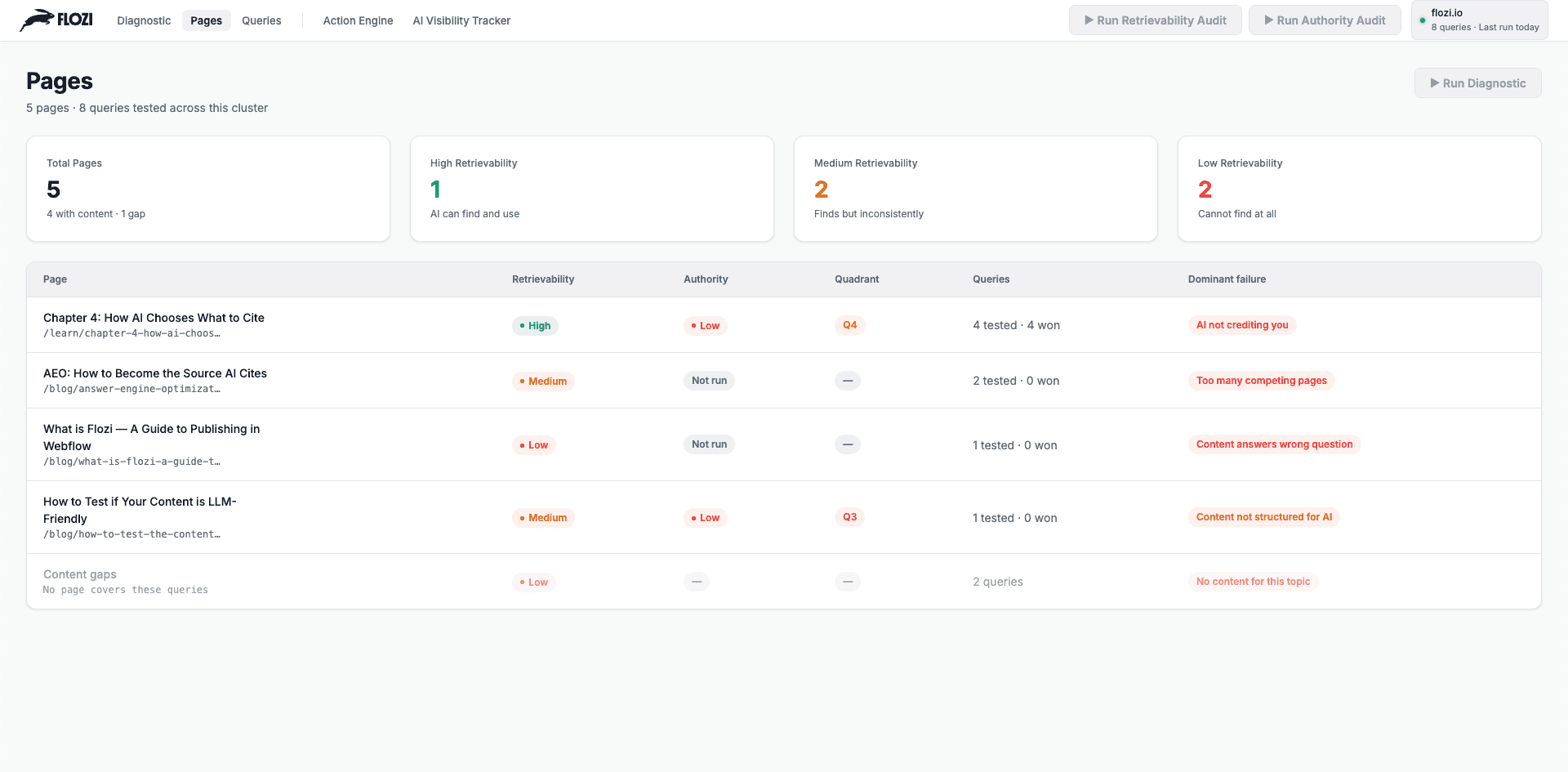
Pages view: per-page retrievability, authority, quadrant placement, and why each page is underperforming in AI answers.
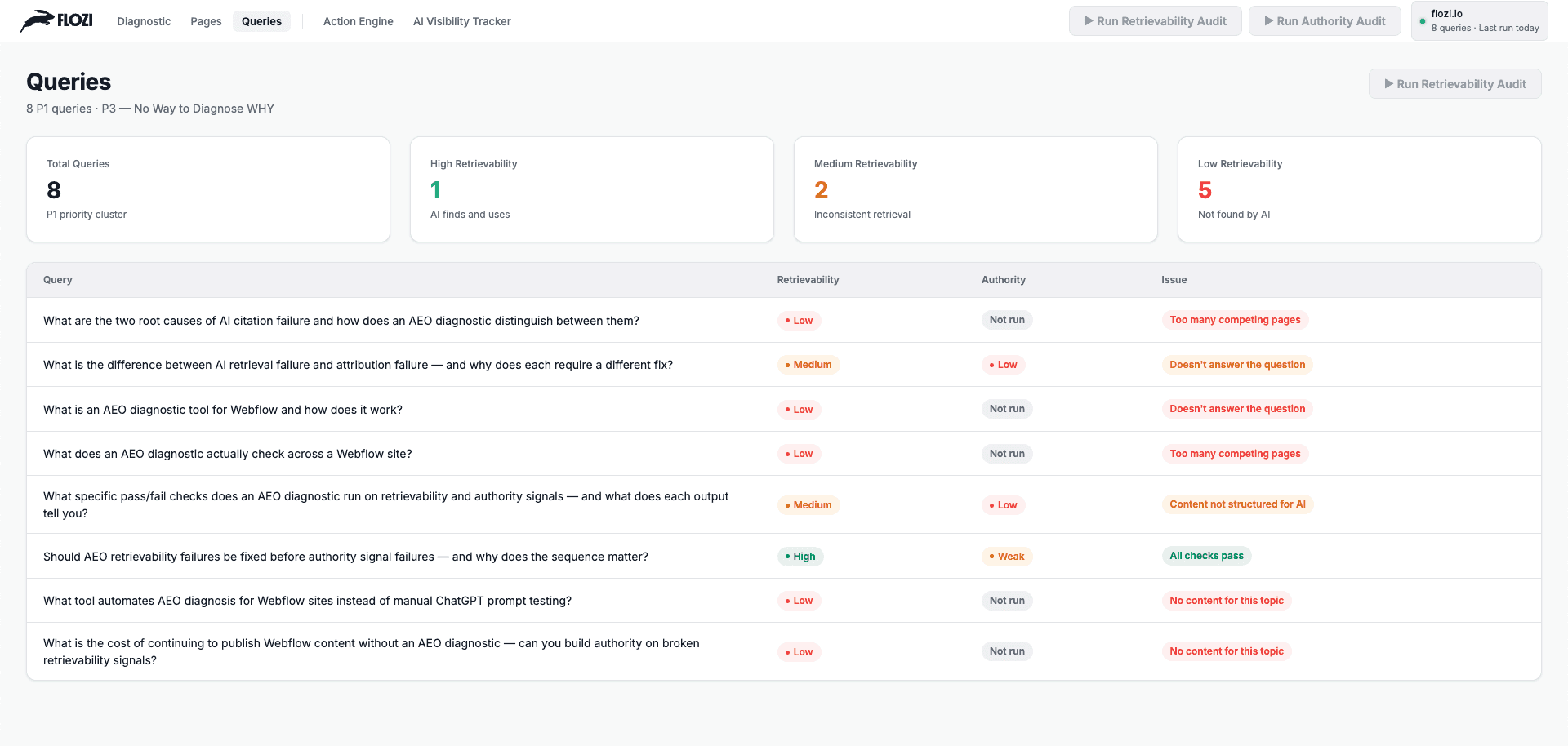
Queries view: each target query with its retrievability level, authority status, and the specific issue blocking AI inclusion.
The four quadrants (and what each one means for you)
Invisible zone (low retrievability, low authority). AI can’t find you and doesn’t know you. This is where new sites live, or sites with fundamental technical issues. Content optimization won’t help until the technical gate is cleared.
Commodity zone (high retrievability, low authority). The most painful spot. Rankings look decent. Content is clean. But AI systems are using the material and dropping the brand. The citation loss ratio is high. You’re providing value with no credit.
Latent brand zone (low retrievability, high authority). The AI has some model of your brand from training data, so it shows up for brand-specific queries. But informational searches, comparative queries, category-level questions? You’re absent. Common for established companies that haven’t structured content for retrieval.
Dominance zone (high retrievability, high authority). Retrieved consistently, cited by name, and the AI explains the topic using your framework. This is the only durable position. Everything in Flozi is designed to move content clusters here.
The AEO Advisor: Where to Focus and How to Advance
Once every cluster is placed in a quadrant, AEO Adviser generates page-level instructions. Not “improve content quality.” Actual directives:
“Split this cluster into two distinct pages to resolve semantic blur on this query set.”
“Add a comparison structure to section 3 to address missing comparative coverage.”
“Introduce a named framework in the opening section to anchor attribution.”
The Advisor also runs gravity phrase analysis. If a competitor is getting cited and you’re not, this shows the structural reason why: which distinctive terms and framing patterns are present in their content and missing from yours.
For clusters stuck in the commodity zone (high retrieval, low authority), the Advisor goes further with strategic authority-building plans. It pinpoints which gravity phrases are missing and recommends the content patterns that anchor attribution: named frameworks the AI has to reference, explicit constraint logic (“when this works, when it doesn’t”) that’s hard to abstract away, and terminology specific enough to survive the compression of AI synthesis. This is how abstractable content becomes content that carries your brand through the synthesis process.

Action Engine: prioritized actions ordered by impact, each with a resolution plan naming specific pages and URLs to fix.
The Visibility Tracker: Anticipating Shifts to Capture More Traffic
Most content teams know when their traffic drops. Almost none know when AI stops recommending them, and by the time they notice, the damage is done.
The Visibility Tracker changes that. Instead of a one-time static baseline, it maps your position on a two-axis grid (Retrievability versus Authority) across every mapping update, so you can see not just where you are but where you’re moving.
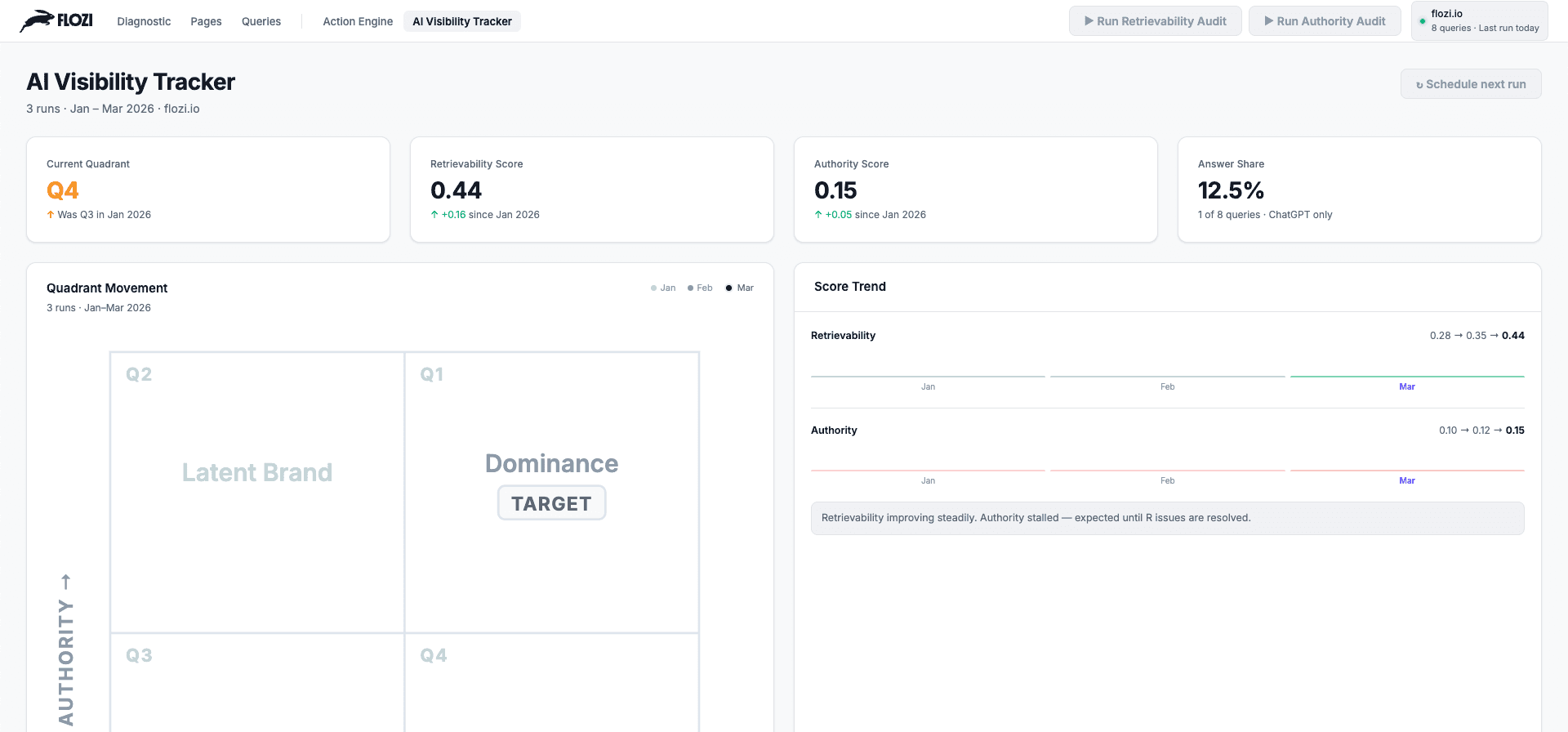
AI Visibility Tracker: quadrant movement from Invisible to Commodity over three runs, with score trends and answer share.
A dot in the Invisible zone that shifts toward Commodity tells a precise story: AI is starting to find your content, but still crediting competitors. A dot moving toward Dominance means both signals are strengthening. become the source AI quotes, not just the page it reads.
That trajectory is the metric. Not rankings, not impressions. The actual direction of your AI visibility over time.
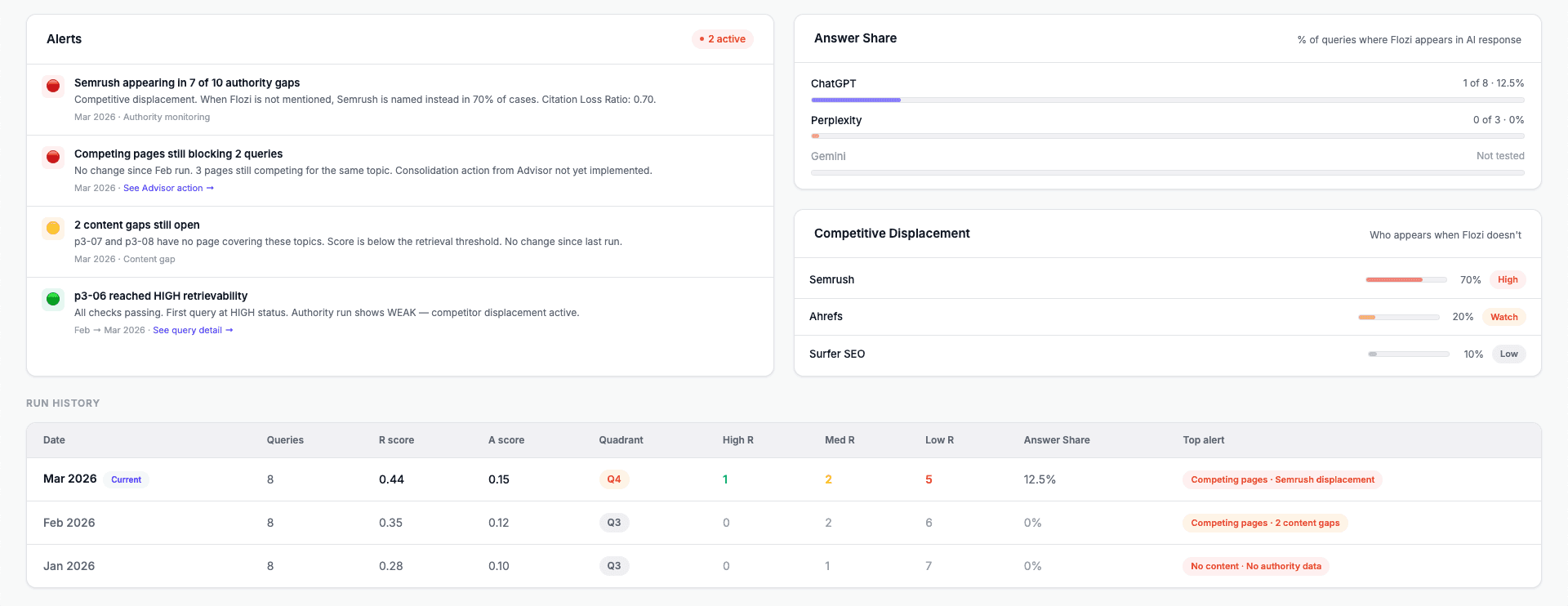
Tracker alerts: which competitors appear when you don’t, answer share across ChatGPT, Perplexity, and Gemini, plus full run history.
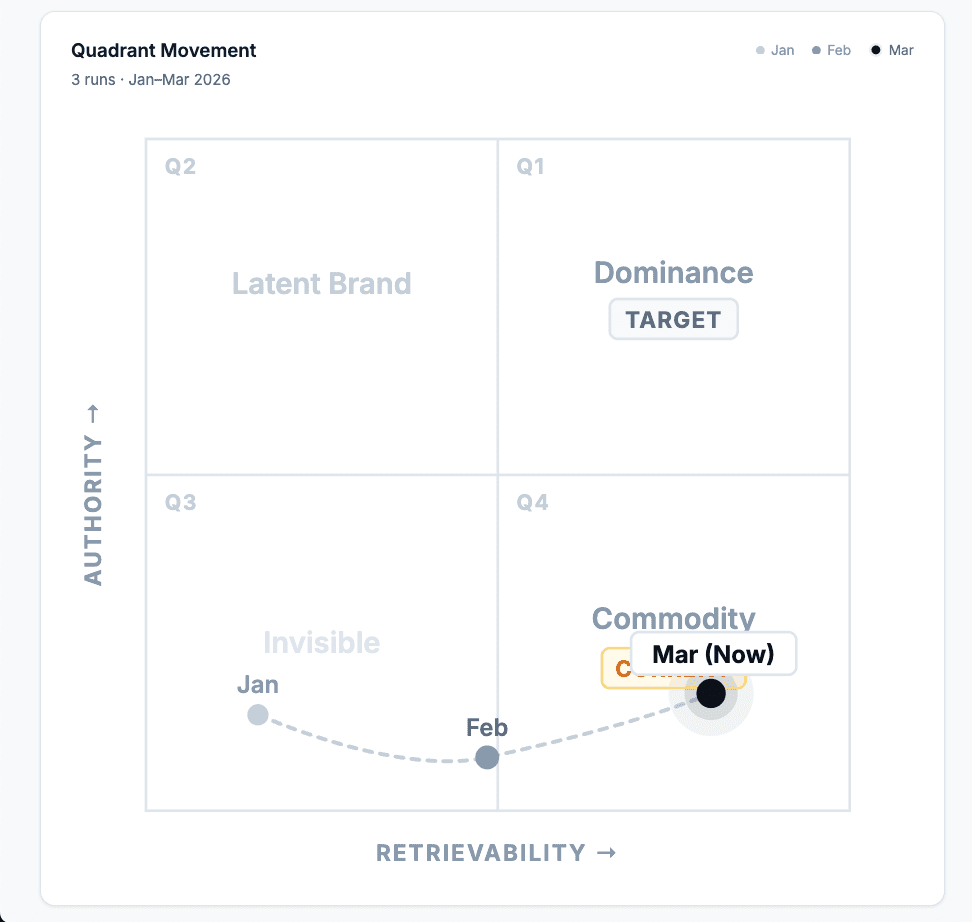
Quadrant movement over three runs. The trajectory shows direction of AI visibility, with Q1 Dominance as the target.
Frequently Asked Questions
What is AEO (AI Engine Optimization)?
Answer Engine Optimization (AEO) Unlike traditional SEO, which focuses on ranking in search results, AEO focuses on becoming the cited source inside the answer itself.
Why doesn’t my website show up in ChatGPT or Perplexity?
There are three common reasons. First, your content may not be technically accessible to AI crawlers. Second, your site may have semantic blur, where multiple pages compete for the same query and none looks definitive. Third, your content may lack the structure and specificity that LLMs prioritize when choosing between candidates.
What is Flozi?
Flozi is an AEO platform built specifically for Webflow sites. It diagnoses why your content isn’t showing up in AI answers and gives you a concrete plan to fix it. The platform covers four stages: discovery (where you stand), advise (what to fix), build authority (how to anchor attribution), and track (monitoring shifts over time).
How does Flozi work?
Flozi crawls your site, classifies every page by intent, and places each content cluster on a quadrant grid measuring retrievability and authority. From there it generates page-level directives, runs gravity phrase analysis to show why competitors get cited instead of you, and tracks your AI visibility trajectory across updates so you can catch drops before they cost you traffic.
What is a citation loss ratio?
The citation loss ratio measures how often AI systems use your content versus how often they actually name your brand. A 1:1 ratio means strong attribution. A 10:1 ratio means your ideas are being absorbed and repeated without credit, effectively ghost-writing for AI answers.
What is semantic blur and why does it matter for AI visibility?
Semantic blur happens when multiple pages on your site are nearly identical in relevance to a given query. We measure it as the similarity gap between your top-matching content chunk and the second-closest internal chunk. A low gap means AI systems can’t confidently pick one page, so they skip your site entirely.
What are gravity phrases?
Gravity phrases are terms and framing patterns distinctive enough that AI systems have to attribute them to a source. Named frameworks, proprietary terminology, and specific methodologies all function as gravity phrases. Generic language gets absorbed without a trace. Distinctive language forces citation.
How is AEO different from SEO?
SEO optimizes for rankings and clicks on search engine results pages. why AEO is essential for citations The two are complementary: strong SEO foundations support AI retrievability, but ranking well doesn’t guarantee you’ll be cited, included, or even mentioned in AI-generated responses.
Can AEO help if my site already ranks well on Google?
Yes, and in fact sites that rank well are often the most vulnerable. High-ranking content is exactly what AI systems want to consume, but without the right structural and attribution signals, that content gets used without credit. AEO identifies content absorption and attribution
The Window Is Open
AEO is where SEO was in 2010. The problem is real, the solutions are early, and the sites that build this capability first get to define what good looks like.
“Why doesn’t ChatGPT mention us?” is already a question site owners are asking. Most don’t have a systematic answer yet.
Flozi gives you one. Discovery, advisor, authority builder, and tracker in one platform. Run a diagnosis and get a quadrant map with specific fixes in the time it used to take to write a recommendations doc.
KEEP READING
Keep reading

SEO & AEO
How to Add WebMCP to a Webflow Form (And How to Test It)
A practical guide to adding WebMCP to a Webflow form, with the code, the origin trial setup and a testing checklist

SEO & AEO
Schema Markup & AI Citations: What Studies Show
Discover if schema markup improves AI citations and SEO rankings. Recent Ahrefs, Search Atlas & Google data reveal the truth on structured data for AEO, GEO, and search visibility in 2026

AEO as an Agency Service: How to Package, Price, and Sell
AI visibility is becoming a client conversation agencies can't avoid. Here's how to build AEO into a service you can actually deliver at scale, not just report on.